Game acoustics,
in real time.
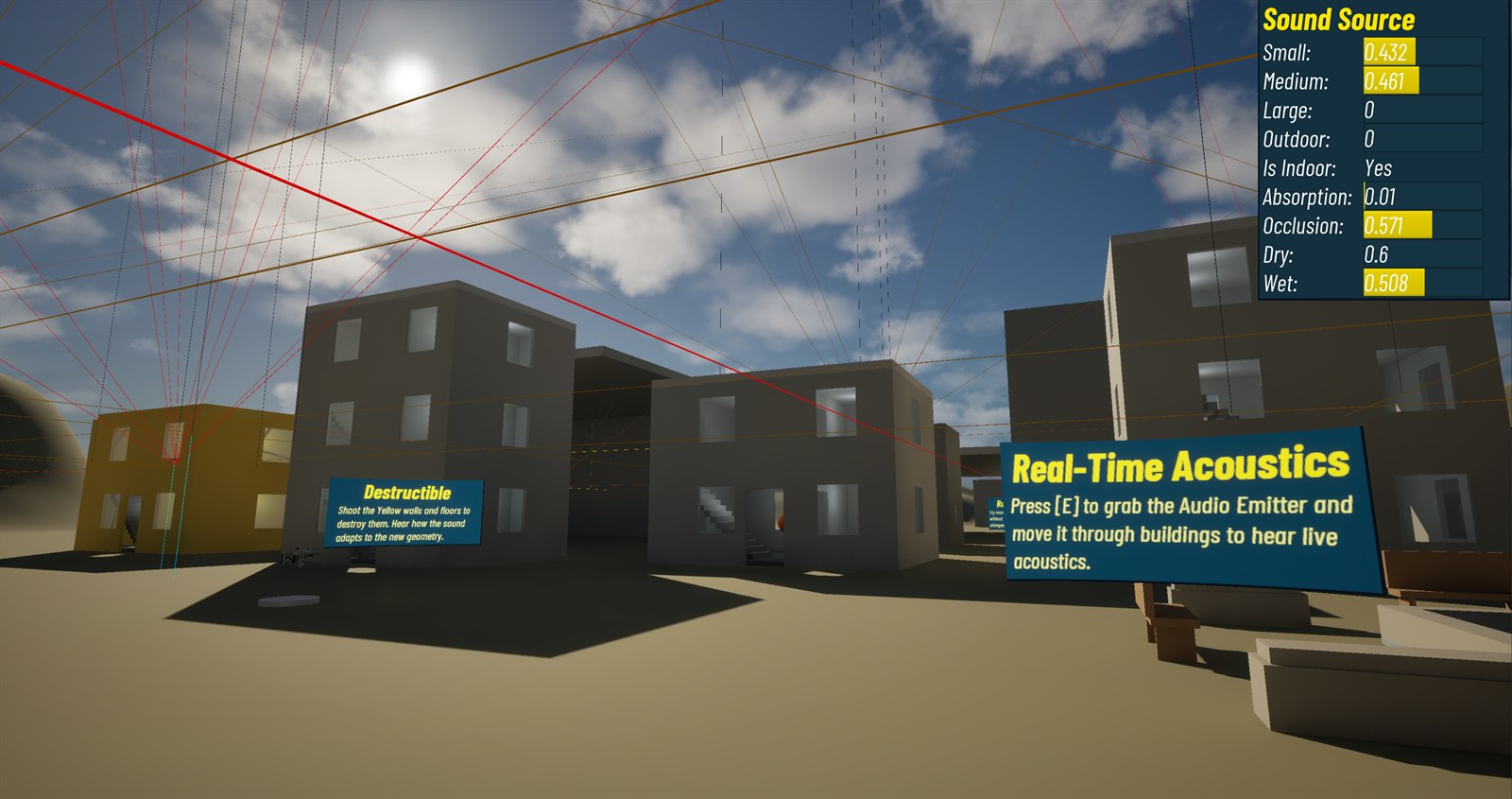
Per-sound-source reverb, early reflections and sound propagation – computed live from scene geometry. No baking, no zoning. Engine-agnostic core SDK, shipping today for Unreal Engine 5 and Wwise.
Why real-time
Hand-placed reverb zones are over. We compute acoustics per sound source, straight from the geometry – so the mix reacts as the world changes.
Capabilities
Per sound source
Every sound source gets its own independent acoustic analysis – real geometric propagation, not a shared room preset.
02Real-time, no baking
Nothing to precompute, no reverb zones to author. Event-based analysis re-evaluates acoustics live whenever a source moves or the world changes – destruction included.
03Built to scale
Bounded cost, not proportional to source count: only the nearest emitters are analysed each frame, within a fixed ray budget spread across frames. Under 1 ms.
04Full acoustic model
Dynamic reverbs, early reflections, occlusion, obstruction, transmission and sound propagation – all computed live from scene geometry.
A dynamic alternative to baked acoustics – chosen over Steam Audio, Project Acoustics and other sound-propagation and audio-raytracing tools when destruction, moving geometry and procedural levels rule out precomputed data.
How it works
From raw scene geometry to a live per-sound-source mix – event-driven, no precompute.
Scene geometry
The live level – including destruction and moving geometry – is read directly. No manual reverb zones to place.
Ray analysis
Rays are cast per sound source and scheduled across frames with LOD, probing occlusion, reflections and paths to the listener.
Acoustic solve
Results resolve into reverb parameters and early-reflection taps for each source.
Live mix
Reverb via UE submixes or Wwise Aux Busses; reflections via a custom delay-line DSP or AK Reflect. The mix reacts as the world changes.
Get it – free trial, fully functional in editor
Co‑development
We build audio
with your team
Beyond the SDK. We take on technical audio work embedded with your studio – scoped case by case, from R&D and prototyping to shipping support.
Technical audio
Audio systems design, engine + middleware integration and pipeline tooling – built to fit how your team already ships.
Audio programming
Low-level DSP, custom runtime features and performance work across UE, Wwise and bespoke engines.
Acoustics
Real-time and baked acoustic systems – propagation, reverb, early reflections and spatial audio tuned to your world.
Case-by-case
Scoped per project: R&D, prototypes, or embedded support through production. Tell us what you need.
Team formerly at
Company names are trademarks of their respective owners, referenced solely to describe individual team members' prior professional experience. No affiliation, partnership or endorsement is implied.
Book a demo
See it
in action.
A live demo call. We'll walk through the tech on our scene and work out what your project needs.
Frequently
asked
What is Excited Waves Acoustics?
A real-time procedural acoustics system for games. It computes reverb, early reflections and sound propagation per sound source, directly from scene geometry – no baking and no manual reverb zones.
How is it different from Steam Audio or Project Acoustics?
Those rely on precomputed / baked acoustic data that assumes a largely static world. Excited Waves analyses geometry in real time, so it keeps working with destruction, moving geometry and procedurally generated levels.
What does it cost in performance?
Under 1 ms of CPU per frame – and bounded, not proportional to the number of sound sources. Each frame the SDK analyses only the nearest emitters (Maximum Active Detectors, default 32) and caps each active detector's ray budget (default 16 rays per frame), with detector ticks spread across frames and distance-based LOD reducing how often distant sources re-evaluate. Adding more sound sources changes which ones are analysed and how often distant ones refresh – not the per-frame cost. Both limits are exposed as project settings. Live stats are shown in the demo video.
Which engines and middleware are supported?
It is engine- and audio-middleware-agnostic by design. Today it ships as an integration for Unreal Engine 5 and Audiokinetic Wwise on Win64.
Is the trial limited?
No – the trial is fully functional inside Unreal Editor with no feature restrictions. Packaging standalone game builds requires a full license.
What does the acoustic model cover?
Dynamic reverbs, early reflections, occlusion, obstruction, transmission and sound propagation – all computed per sound source, live from scene geometry, with no baking and no authored reverb zones. Reverb runs through UE submixes or Wwise Aux Busses; early reflections through a custom delay-line DSP or AK Reflect.